
Living in a cozy Seattle apartment requires a very deliberate approach to spatial management. You cannot afford to hoard items "just in case." Every single object sitting on a shelf or hanging on a rod must actively earn its right to exist in your environment. Because of this, both my boyfriend and I consider ourselves strict minimalists—but our definitions of that word could not be further apart.
My boyfriend’s approach to minimalism is rooted in pure, unadulterated modern utility. If an object does not serve an immediate, daily, visible function, he views it as a waste of space. His entire wardrobe fits comfortably into a single duffel bag: five identical black t-shirts, two pairs of technical performance pants, one heavy weather-resistant shell jacket, and a pair of durable trail runners. To him, clothes are a practical shield against the elements, nothing more.
My minimalism is focused on slow-fashion preservation, circular economics, and aesthetic versatility. I see a closet as a living, breathing archive. I look at a structured vintage garment and see its history, its raw material density, and its potential to be styled in five different ways across an office workweek.
Naturally, this difference in perspective leads to some highly entertaining, good-natured boundary debates when we conduct our seasonal closet audits. He looks at my thrifted collection of oversized menswear blazers, raw silk blouses, and salvaged fabric scraps and sees a mountain of confusing, space-consuming "junk." I look at his worn-out, synthetic gym hoodies and see low-quality material that should have been recycled months ago.
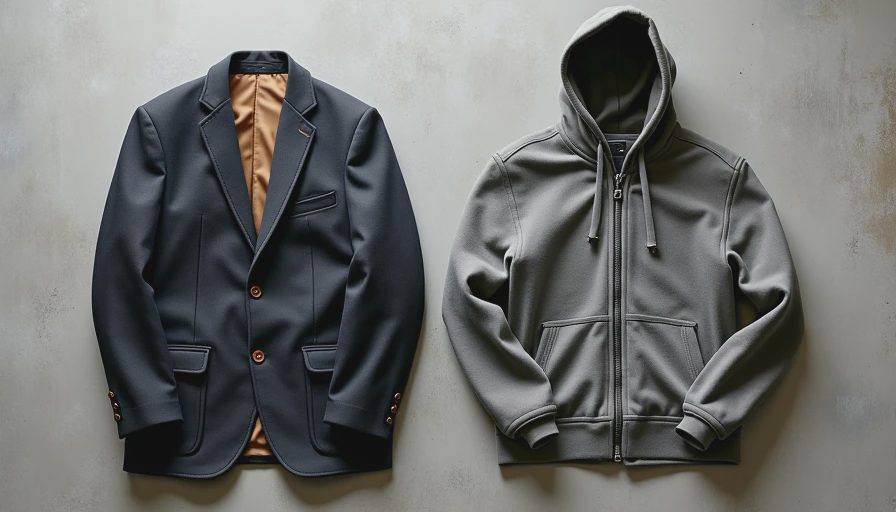
The Divergent Definition Matrix
To understand who wins these domestic style debates, you have to look at the exact criteria each of us uses to judge a piece of clothing. We are looking at the exact same garment through two completely different analytical lenses:
          [The Wardrobe Value Intersection]
                          |
     |--------------------|--------------------|
     |                                         |
[My Boyfriend's Criteria]                [My Curation Criteria]
- Does it repel rain or sweat?          - Is it made of 100% natural fibers?
- Can it be thrown in a hot dryer?      - Does it possess historical tailoring?
- Does it pack down to zero space?      - Can it be remixed into a capsule uniform?
- Is it completely unnoticeable?        - Does it hold its shape under steam?
Case Studies from the Closet Battleground
Let’s look at three real-world garments that have survived (or failed) our apartment boundary tribunals, analyzed by their material reality rather than our personal biases.
1. The Vintage 100% Wool Herringbone Blazer
His Verdict: Junk. It’s heavy, it takes up three regular hanger slots, it can't be thrown into a standard washing machine, and it makes me look like an eccentric 1970s university professor when I wear it around the house.
My Verdict: Treasure. As we established in our thrifted blazer structural audit, vintage menswear outerwear features a floating interior canvas skeleton that is completely non-existent in modern fast-fashion. It holds its pristine structural geometry under a hot steam press, regulates my body temperature perfectly between the chilly morning bus commute and the warm clinic file room, and transforms a casual top into an instant authoritative uniform.
Who Was Right? I am, objectively. While it requires specialized care (hand steaming), a 100% virgin wool textile path will outlast any modern synthetic technical jacket by several decades without ever degrading or contributing microplastics to the water supply.
2. The Micro-Trend Synthetic Workout Hoodie
His Verdict: Treasure. It’s stretchy, it dries in fifteen minutes after a heavy laundry cycle, and it fits easily into the bottom of a backpack.
My Verdict: Junk. The fabric profile is 100% polyester, which means it is essentially woven oil plastic. After a few months of continuous wear, the cheap plastic zipper track has completely warped into a wavy, bacon-like shape. More importantly, synthetic fibers are notoriously oleophilic—meaning they permanently lock in body oil bacteria, causing the fabric to retain a faint, unpleasant odor no matter how many times it gets washed.
Who Was Right? I am. The warped zipper and permanent odor build-up mean the garment has hit its structural dead-end. It cannot be salvaged, it cannot be flipped, and it is destined for a textile downcycling facility.
3. The $9 Cropped Men's Oxford Cotton Shirt
His Verdict: Junk (Initially). When I first brought it home from Goodwill, it was an oversized, billowing men’s XL shirt with trailing shirttails. He literally asked if I was planning to use it as a rags for cleaning the kitchen counters.
My Verdict: Treasure. I saw the raw potential of the material weight. As shown in our recent summer shirt transformation tutorial, thirty minutes of focused execution with a pair of fabric shears and a clean double-fold hem completely changed the game.
Who Was Right? A mutual truce. The moment he saw the finished product styled beautifully with high-rise linen trousers on a hot summer afternoon, he admitted defeat. It proved that a boxy menswear garment can be successfully engineered into a chic, breathable minimalist asset that rivals high-end design boutiques.

The Strategic Wardrobe Asset Matrix
To help you resolve any internal (or external) debates happening inside your own bedroom wardrobe setup, use this clear, material-focused matrix to separate high-value foundations from disposable clutter:
The Analytical Treasure vs. Junk Reference Guide
Garment Characteristic | The True "Treasure" Profile | The Hidden "Junk" Profile | The Long-Term Lifestyle Reality |
Fabric Fiber Source | 100% Natural (Wool, Silk, Cotton, Flax Linen, Hemp). | 100% Synthetic (Polyester, Acrylic, Nylon, Flimsy Rayon). | Synthetics trap heat and odor while degrading rapidly; natural fibers breathe, drape beautifully, and hold their value. |
Seam & Hem Construction | Generous 1-inch hem allowances, lock-stitched parallel interior seams. | Barely-there 1/8-inch serged edges, loose single-thread chain stitches. | Cheap fast-fashion seams snap under the slightest physical friction; high-quality seams can be easily repaired or let out. |
Hardware Components | Genuine horn, carved wood, solid brass, or heavy YKK metal closures. | Ultra-light molded plastic buttons, thin nylon-coil fused zippers. | Plastic components crack under standard ironing heat and warp permanently, ruining the entire line of the garment. |
Styling Versatility Metric | Can be successfully integrated into at least 5 distinct capsule uniform combinations. | Can only be worn with one specific item or fits a single fleeting internet trend. | Single-use clothing items cause high decision fatigue and drain your hard-earned receptionist savings account. |
The True Balance of a Shared Space
At the end of the day, the great "Treasure vs. Junk" debate isn't actually about winning an argument. It’s a healthy check-and-balance system for a conscious lifestyle. My boyfriend’s hyper-functional lens keeps me grounded—it prevents me from bringing home beautiful but ultimately useless vintage pieces that don't fit my actual daily life. On the flip side, my material-conscious, slow-fashion lens has taught him to look past the initial convenience of cheap synthetic clothes and invest in durable, high-quality natural fibers that stand the test of time.
True wardrobe contentment doesn't come from having an infinite, flawless collection of clothing, nor does it come from living out of a sterile, empty box. It comes from knowing the exact structural worth of everything you own.
When you learn to look past marketing trends, ignore peer pressure, and judge a garment strictly by its fiber integrity, seam geography, and daily real-world utility, you unlock a profound sense of financial and mental peace. Hold onto the pieces that respect your body and your wallet, mend the things that can be saved, and let go of the low-quality clutter that no longer serves your journey toward a truly intentional life.





No comments yet — grab the first one.