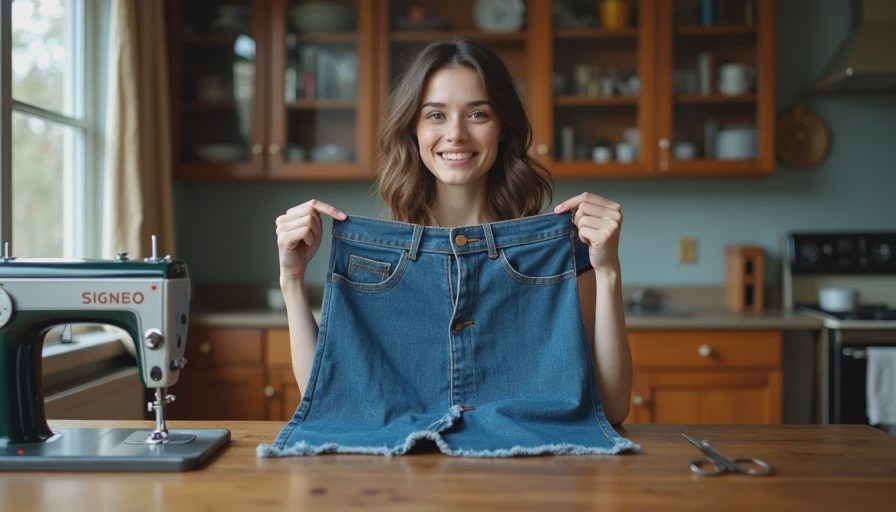
If you spend even twenty minutes scrolling through TikTok or Pinterest looking for thrift flip ideas for beginners, you will find an endless stream of effortlessly flawless transformations. A creator will buy a massive, frumpy, triple-XL vintage men's button-down shirt or an absolute tent of a maxi dress for three dollars at Goodwill. They make a few quick, effortless cuts with a pair of shiny fabric scissors, run it through a sewing machine for what looks like three seconds, and suddenly they are modeling a stunning, custom-tailored, high-end boutique co-ord set that fits their body perfectly.
Let me tell you the absolute truth as a self-taught creator : those videos are a massive lie.
They completely edit out the hours of technical frustration, the jammed bobbins, the broken needles, the accidental holes, and the moments where you sit back, look at what you’ve just created, and realize it is completely unwearable. When I first started experimenting with clothing modifications to build a sustainable wardrobe on a tight paycheck, I assumed it would be easy. I watched a couple of quick video clips, felt a burst of creative confidence, and went straight to work without knowing a single thing about fabric mechanics, structural grainlines, or machine tension.
The result was an absolute, unmitigated disaster. I didn't create a chic, sustainable statement piece; I took a perfectly good, durable secondhand garment and turned it into literal trash. It was incredibly discouraging, and I almost packed up my sewing machine to give up on the whole lifestyle entirely.
Anatomy of a Failure: The Frankenstein Skirt
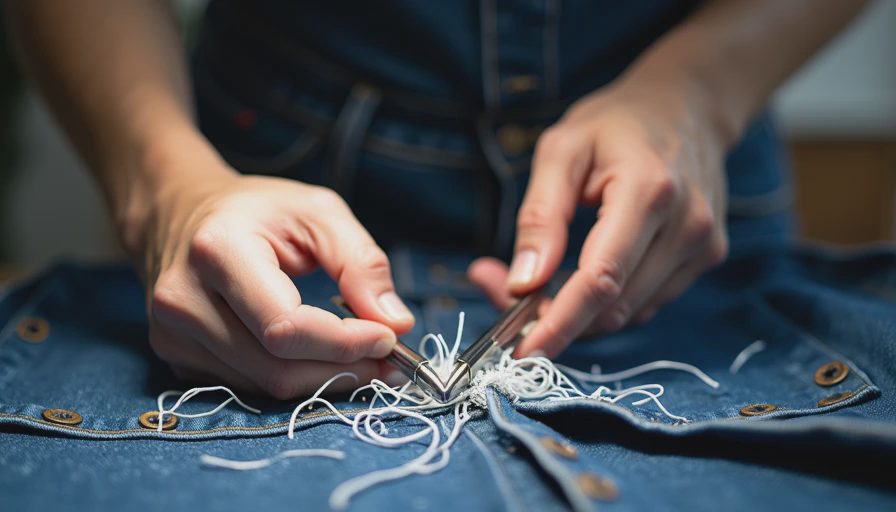
The victim of my very first upcycling project was a beautiful, vintage midi-length heavy denim wrap skirt that I found in the women's section at a local thrift shop for just six dollars. The fabric tag was 100% heavy, structured cotton—exactly the kind of material I always tell people to look for. It had a gorgeous, rich indigo wash and heavy duty metal snaps. The only issue was that it was about three sizes too large around my waist, and the length hit my legs at a really awkward, frumpy angle that made me look like I was wearing a heavy canvas tent.
My brilliant plan was to chop the skirt in half to create a trendy, high-waisted mini-skirt, and then use the leftover fabric scraps to sew two cute patch pockets onto the front. It sounded so simple in my head. I grabbed my scissors, skipped the pins, ignored my measuring tape, and went to work on our apartment dining table.
Here is exactly what went wrong during that fateful sewing session:
    [The Golden Vision] ---> Transform an oversized $6 denim midi skirt into a tailored mini-skirt
             |
    [Mistake 1: No Pins] ---> Eyeballed the cutline, resulting in a comically crooked, wavy hem
             |
    [Mistake 2: Tension] ---> Forced thick denim through a light needle, creating massive thread jams
             |
    [Mistake 3: Grain]   ---> Sewed patch pockets sideways, causing the fabric to pucker and warp
             |
    [The Final Outcome]  ---> An asymmetrical, unwearable mess that went straight to the scrap bin
When I stepped into the hallway mirror to try on the finished product, I didn't look like a stylish, conscious fashion blogger. I looked like a cartoon character. The hemline was completely crooked—it was two inches shorter on the right side than it was on the left. The waistband puckered so severely that it stood straight out from my lower back like a rigid shelf, and the patch pockets were completely asymmetrical and warped out of shape because I had sewn them on a weird bias stretch. It was totally unwearable. I couldn't even donate it back to Goodwill because I had hacked up the fabric structure so badly.
The 4 Critical Sewing Mistakes I Learned the Hard Way
That failed denim skirt sat in my closet scrap bin for months as a source of guilt, but it ended up teaching me more about the reality of garment construction than twenty successful projects ever could. When you don't go to fashion school and rely on self-taught YouTube tutorials, failure is your absolute best instructor.
Here are the four technical mistakes I made during that project, along with the precise fixes you need to know before you start modifying your own secondhand finds:
1. The Myth of "Eyeballing" the Cut Line
When you see a creator on social media cut across a pair of trousers or a dress with fluid, uninterrupted motions, what you aren't seeing is the meticulous prep work underneath. I thought I could just lay the skirt flat and guess where a straight line was.
The Reality: Fabrics are fluid, shifting structures. If you do not use a hard straight edge, clear tailor's chalk, and a proper acrylic sewing ruler to draw a physical line before cutting, your blade will follow the micro-shifts of the textile threads. You will invariably end up with a hemline that is jagged and completely uneven.
The Fix: Always hang the garment on a dress form or wear it in front of a mirror first. Mark your desired length with straight pins while the garment is on your body. Then, lay it completely flat on a hard table, use a ruler to measure an equal distance from the original hemline all the way across, draw a distinct line with chalk, and only then pick up your fabric scissors.
2. Ignoring the Absolute Law of the Fabric Grainline
Every woven garment is constructed using an intentional grid of vertical threads (the warp) and horizontal threads (the weft). The vertical direction is known as the grainline, and it possesses almost zero stretch, allowing the garment to hang straight down your body cleanly.
When I cut out my patch pockets from the bottom scraps of the skirt, I casually rotated the fabric sideways to make it fit onto a smaller scrap piece. By doing that, I turned the horizontal weft threads vertical. The moment I sewed those pockets onto the heavy vertical grain of the skirt body, the two opposing tensions began to pull against one another. The first time I ran it through a wash cycle, the fabric puckered, buckled, and twisted into an unfixable, wavy mess.
3. Using the Exact Same Needle for Every Single Fabric Type
When you buy a standard sewing machine, it usually comes pre-installed with a universal size 80/12 needle. I assumed that a needle was a needle, and it could pierce through anything.
Heavy denim is an incredibly dense, tightly woven textile. Trying to force a standard universal needle through four layers of thick denim at a high speed caused my machine's motor to struggle, bent the needle shaft out of alignment, and created massive, tangled loops of thread underneath the throat plate—a phenomenon sewers call a "bird's nest."
4. Forgetting to Account for the Crucial "Seam Allowance"
If you want a skirt to measure exactly 16 inches in total length when finished, you cannot cut the fabric at exactly 16 inches. I completely forgot that to create a clean, rolled hem at the bottom, you have to fold the raw fabric edge under twice to prevent it from fraying. That folding process requires at least an inch or two of extra material. Because I cut the denim exactly where I wanted it to end, my finished hem pulled the skirt up so high that it turned into a micro-mini that I couldn't possibly wear to my job at the dental clinic.
Technical Troubleshooting: Setting Up for Success
To save yourself from the heartbreak of an upcycling failure, take a quick look at this essential reference matrix before you flip your next garment. Having the correct hardware and technical settings configured on your machine is half the battle.
Fabric Type and Machine Setup Reference Guide
Sourced Fabric Profile | Common Thrift Examples | Proper Needle Size | Thread Selection | Crucial Setting Tip |
Heavy-Weight Woven | Denim jackets, corduroy pants, canvas utility coats | Size 90/14 or 100/16 (Jeans/Denim Needle) | Heavy-duty polyester thread | Increase your stitch length to 3.0mm or 3.5mm so the machine can cleanly step over thick seam intersections. |
Medium-Weight Woven | Vintage wool blazers, structured cotton shirts, linen skirts | Size 80/12 (Universal or Sharp Needle) | Standard all-purpose polyester or cotton thread | Keep your stitch length at a standard 2.5mm; perform a thorough garment quality check on seams first. |
Light-Weight Delicate | Vintage silk blouses, sheer rayon shirts, fine scarves | Size 60/8 or 70/10 (Microtex or Sharp Needle) | Fine silk or lightweight polyester thread | Lower your top thread tension slightly to prevent the delicate seams from puckering or pulling tight. |
Stretch Knit Fabrics | Oversized sweatshirts, cotton t-shirts, ribbed cardigans | Size 75/11 or 80/12 (Ballpoint or Stretch Needle) | All-purpose polyester thread | Never use a straight stitch. Use a narrow zig-zag stitch or a stretch stitch so the thread can stretch along with the fabric without snapping. |
If you take the extra three minutes to swap out your needle and adjust your stitch lengths based on this table before starting a project, you will instantly eliminate about 80% of common beginner sewing machine jams and fabric damage.
How I Reconfigured My Approach to Upcycling
After that massive failure, I took a giant step back. I realized that I couldn't just wing it every time if I wanted to build a genuinely sustainable, highly wearable closet on a tight budget. I sat down on my bed on Friday nights and poured through hours of practical, slow-paced beginner videos from YouTube channels like Blue Willa and Catherine Sews.
My Reconfigured DIY Project Workflow Blueprint

   [1. The Daylight Audit]   ---> Inspect fabric grainlines, tags, and seam wear patterns
             |
   [2. The Pin & Try-On]     ---> Pin alterations and wear the item to test movement & comfort
             |
   [3. The Chalk Mapping]    ---> Draw exact cut and stitch lines using an acrylic ruler
             |
   [4. The Scrap Test]       ---> Test machine tension and needle depth on small fabric scraps
             |
   [5. The Final Assembly]   ---> Sew slowly and methodically with the correct tool configurations
I completely stopped treating my thrift flips like fast-fashion experiments and started treating them like real engineering projects. I developed a strict, multi-step workflow that I now follow every single time I pull a garment out of my shopping bag.
First, I never cut a garment the same day I buy it. I wash it, hang it up, and look at it for at least a few days while searching for styling ideas on Pinterest. Second, I always do a thorough test run on a small, leftover fabric scrap before I run the main garment through my machine feed dogs. This allows me to perfectly dial in my upper thread tension and ensure my needle isn't going to chew up the material.
Most importantly, I learned to embrace the seam ripper as my absolute best friend. If a seam line looks slightly crooked or tight, I don't just shrug and keep sewing. I stop immediately, sit under a high-brightness task light, carefully rip out the bad stitches, and sew it again properly.
You Don't Need Flawless Technique to Make Progress
The entire point of Shelf & Seam is to break down the toxic, perfect standards we see online. Sustainability isn't a flawless performance art piece where you instantly master a collection of advanced artisan skills overnight. It is a messy, deeply human process of trial, error, and gradual habit building.
You are going to make mistakes. You are going to cut a piece of fabric too short, jam your bobbin casing, or sew a sleeve on completely backward at least once. When that happens, do not feel like a failure, and don't throw your machine back into the closet. Laugh at the absolute absurdity of the mistake, grab your seam ripper, learn from the grainline structure, and try it again.
Our closets don't need to be filled with flawless, factory-perfect designs. They need to be filled with pieces that carry a real history, fit our everyday lives, and remind us that we are capable of fixing, altering, and maintaining the world around us with our own two hands. So buy that cheap, oversized thrift store item, grab your measuring tape, and don't be afraid to make a total mess on your first try.



No comments yet — grab the first one.